

Conclusion first:Whether an old-wall renovation can be fast does not depend on how thin the material is, but on three things:What was this wall originally、Should we suspend operations?、How long is the time windowFor the same wall, the method can differ by three times the construction period.
First: assess the wall surface before discussing the construction schedule
The most common misjudgment on renovation projects is quoting an "old wall" using the procedures for a "new wall." On arrival, if the surface is found to be dusting, hollow, or old tile, the method changes entirely, the schedule changes entirely, and the quote changes accordingly. So the first step in renovation is not choosing materials, but assessing the wall.
After the assessment, walls fall into only three types: those that can be installed directly, those that need treatment before installation, and those that must be stripped down to the substrate before work. The three types of walls correspond to three sets of processes, three types of schedules, and three types of costs.

II. Four-step determination method
No professional instruments are needed on site; four steps are enough for a qualitative assessment:
- Tap.Score and tap with a small hammer to listen for hollow spots. Mark out the areas where the sound is hollow; the marked area determines whether chipping is needed later.
- Scrape.Scrape the surface with a key or putty knife; if powder can be scraped off, it is a dusting layer and must be removed. If it cannot be scraped off, the strength is sufficient.
- Cross-cut.On the old paint surface, score a crosshatch pattern, apply tape and pull it off to see whether the coating peels. Peeling indicates insufficient adhesion, and it cannot be directly overcoated.
- Measure flatness.A two-meter straightedge plus a feeler gauge, recording out-of-tolerance locations. Thin sheets are sensitive to flatness, and areas with large deviations must be leveled first.
Once the four steps are done, the wall falls into one of three categories. This judgment must be documented: photos, location, area, conclusion. Eighty percent of disputes in renovation projects stem from "no record at the time."
Third, the first category: walls that can be applied directly
The conditions are: the substrate has sufficient strength, no hollowing, flatness within the allowable range, the old coating adheres firmly, and the moisture content meets the standard. If these five conditions are met, primer treatment can be applied directly before pasting.
The process is very short: cleaning → repairing local defects → interface treatment → setting out lines → pasting → pointing → cleaning. This is the real basis on which "quick installation" can hold—not because the material is magical, but because the wall itself is up to standard.
One reminder: being directly applicable does not mean interface treatment can be skipped. Old wall surfaces often carry oil, dust, and old coating residue; interface treatment is the step that turns "can be applied" into "adheres firmly."
IV. The second category: walls that require treatment before application
Typical cases are localized hollowing, localized cracking, localized dusting and slight unevenness. The approach is "localized treatment + overall interface":
- Cut open the hollow areas, remove them down to the dense substrate, and re-repair and level.
- Treat cracks by width: seal fine cracks with elastic repair material; for wide cracks, cut a groove, fill it in, then repair.
- Areas with sanding must be removed or treated with penetrating consolidation; adhesive must not be applied directly.
- Apply a full-surface interface treatment to ensure the old and new interfaces are consistent.
This type has the greatest schedule uncertainty, because how big "local" actually is can only be known after removal. When quoting, the basis of "settlement according to actual quantities" should be agreed upon, rather than a fixed lump sum—with a fixed lump-sum quote, the contractor will certainly make it back elsewhere.
V. The third category: walls that must be stripped down to the substrate
Large-area hollowing, large-area peeling, entire sheets of old tile coming loose, insufficient substrate strength—for these there is no shortcut; they must be removed and redone. Forcing a cover-up is equivalent to sealing the hidden problem inside; a year or two later it will peel off in large patches, and the rework cost will be far higher than removing it in the first place.
This type has the longest process: removal → debris clearing and transport → substrate repair → leveling → curing → interface → bonding → pointing. The construction period is usually three to five times that of the first type, and debris removal and curing wait time must also be included.
Where is the critical point for judging that "it must be scraped off"? The practical rule is: if the hollow area exceeds an agreed proportion, or the hollowing is distributed in continuous patches, treat the entire surface. Isolated single spots can be repaired, but continuous patches require treating the entire surface.
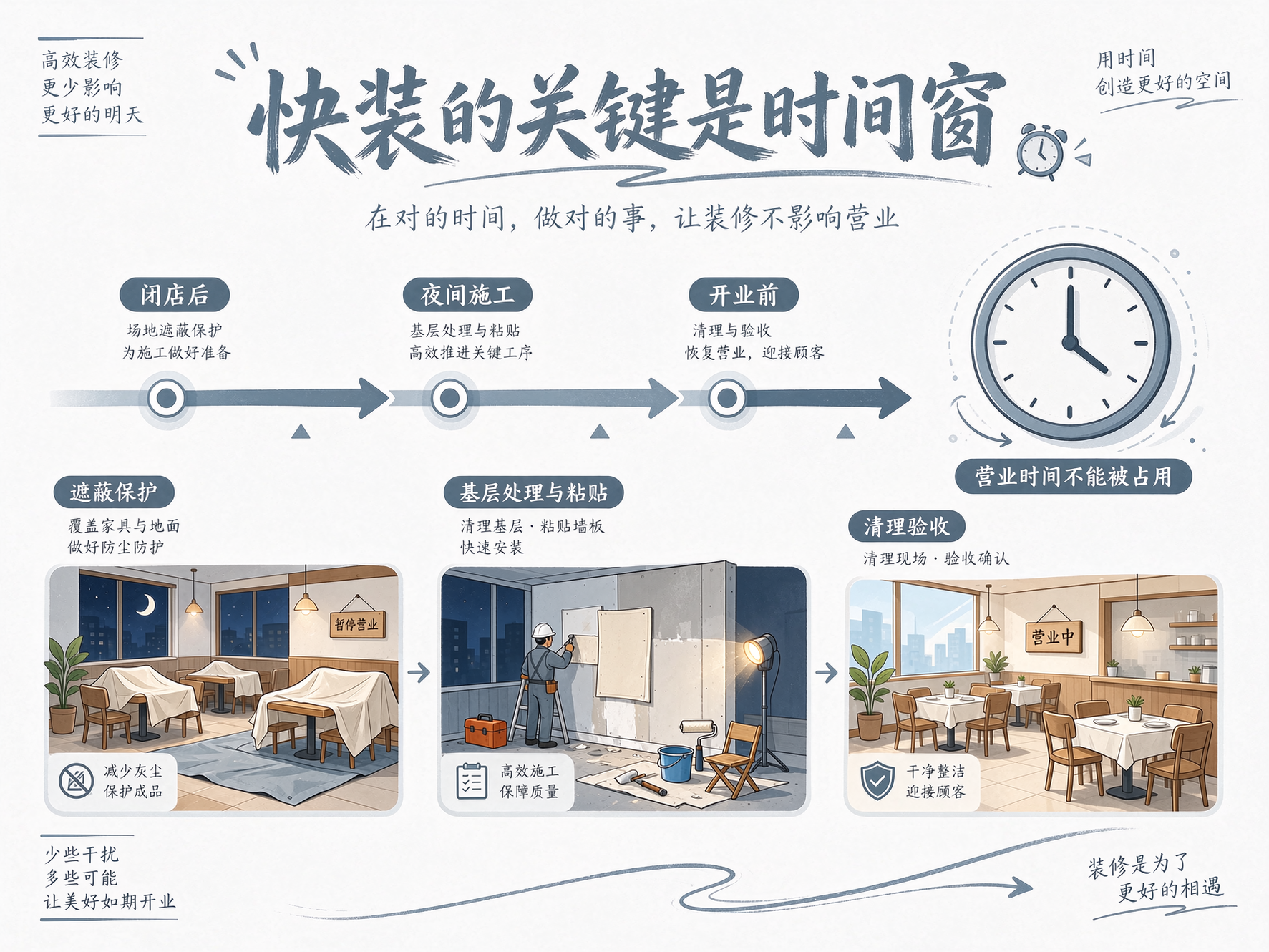
VI. The key to fast installation is the time window
In renovations for restaurants, hotels and chain stores, the real constraint is not money but business hours. The store must open for business during the day, so construction can only be squeezed into the few hours after closing. At this point the meaning of "fast installation" changes: it is not "doing it fast" but "finishing it within the window and delivering it clean."
A usable time window is usually divided into three segments:
- After closing: masking and preparation.Hoarding, covering furniture and equipment, laying protective film, and material entry. This stage produces no visible progress, but it determines whether business can operate normally the next day.
- Night work: main operations.Substrate treatment, adhesion, joint filling. Processes with high noise and dust must be placed in this section and controlled within the time periods permitted by property management.
- Before opening: cleaning and acceptance.Site clearance, removal of coverings, cleaning, self-inspection, and handover. Sufficient time must be reserved for this stage; it cannot be squeezed into the last five minutes.
VII. How to schedule construction without shutting down operations
For large-area renovation without wanting to suspend business, the key is "zoning + time scheduling":
- Zoning.Divide the wall into several work zones according to the business circulation route, work on only one zone at a time, and keep the other zones in normal use. The zone boundaries must work together with sightline screening—customers must not see the side under construction.
- Time-phasing.Noisy processes are concentrated after closing time; quiet processes (adhesive application, joint filling) can be moved to low-peak daytime hours.
- Delivered in sections.Clean up and hand over after each zone is completed; do not wait until everything is done to clear the site all at once. This way the sales area is always "clean."
This arrangement places higher demands on construction organization than on materials. No matter how thin the material is, if the organization cannot keep up, it will still be delayed enough to affect business.
VIII. Three Types of Old Surface Layers, Three Types of Treatment
Old tile surface.The premise is that the tiles are not hollow. The method is roughening treatment + suitable interface material + bonding. Hollow tiles must be removed first—the back of the tile has already separated from the substrate, so covering it is equivalent to sticking onto an empty shell.
Old paint surface.First conduct an adhesion test. Firmly adhered areas should be sanded and then overcoated; peeling or powdered areas should be removed. A common problem with latex-painted walls is that "the surface looks good but the substrate has already powdered"; a cross-cut test can detect this.
Old wood veneer and old wall panels.Check whether the substrate board has absorbed moisture and deformed. Any that has absorbed moisture must be removed first and must not be covered—if moisture is sealed inside, the new finish will quickly blister.
The common principle for the three types of surface layers: first solve "adhesion," then consider "covering."
IX. The cost traps of renovation
The four items most easily omitted from renovation quotations are also the four items that incur the most additional costs later:
- Removal and disposal.Construction waste generated by wall stripping must be removed and disposed of, with costs calculated per truck or per ton, which is often overlooked.
- Substrate repair.The amount of repair after stripping cannot be estimated in advance; "settlement based on actual quantities" must specify unit prices.
- Finished product protection.Renovation is carried out in spaces that are in use, so the cost of protecting furniture, equipment and floors must be included.
- Night work surcharge.Night work, artificial lighting and noise-reduction measures all increase costs.
Together, these four items often account for a considerable proportion of the total price. Listing them clearly in the quotation is much cheaper than explaining afterward. For the complete logic of cost breakdown, refer to 2026 quotation six items and Full life-cycle cost。
X. Why Thin-Sheet Facing Is Suitable for Renovation
Three reasons, all related to "old":
- Does not add too much load.The old wall is already bearing the original surface layer. The thin sheet is light in weight (about 3–7kg/㎡), so the additional load on the original structure is small. This is the most practical consideration for renovating old buildings.
- Can handle special shapes.Old buildings have many columns, curved walls, and irregular corners; thin sheets can bend and are easier to fit to the original structure than thick panels.
- The process is relatively short.No steel frame and no dry-hanging keel are needed, reducing the amount of drilling and welding work in existing spaces.
Its boundaries must also be stated clearly: walls only, not floors; no insulation; no structural reinforcement. If an old renovation project involves exterior wall insulation and fireproofing construction, that is another system, see Exterior wall fire protection boundaries With the exterior wall article in the same section.
XI. Five Common Questions
Q: When renovating an old wall, must it be stripped down to the cement layer?Not necessary. A wall with firm adhesion, no hollowing and sufficient strength can be directly covered after treatment. Only walls with continuous hollowing, severe peeling or insufficient strength need to be scraped down to the substrate.
Q: How many days does it take to renovate a restaurant?Depends on the wall classification and area. For walls that can be applied directly, a considerable area can be completed within the nighttime window; for walls that must be scraped off, the time for scraping, repair and curing must be added. The wall must be assessed before a schedule can be given.
Q: Can construction proceed while the business remains open?Yes, but delivery must be phased by zone, time, and stage, and masking must be done well. Areas along the customer circulation path must not have exposed dust or tools during construction.
Q: If applied directly onto old tiles, will it fall off?If the tiles are not hollow or debonded, have been roughened and given interface treatment, and are installed with the matching adhesive, they normally will not fall. Conversely, if the tiles are already hollow or debonded and are still forced on, falling is only a matter of time.
Q: What if the renovated result does not match the original style?Renovation often involves the situation of "renovating only one wall." The approach is to select models in the same color family and with the same texture for transition, or use edge trim to create a clear interface, avoiding direct joining of new and old materials.
XIII. How to estimate the schedule so it won't be overturned on site
The most common mistake in renovation schedules is working backward from "the efficiency of a new wall." The correct approach is to estimate each of the four stages separately, then add them together:
- Removal section.Estimate by area and removal difficulty, including bagging and disposal of debris. This stage cannot be compressed; if removal is not thorough, everything after it is wasted.
- Repair and curing section.After repair and leveling, curing is required, and no bonding may be done during the curing period. This step is often skipped as a "by the way," and the result is that the substrate is still not dry when bonding is done.
- Adhesion section.Estimate based on the effective working area, not headcount. When the working area is cut off by customer circulation routes, efficiency drops far more than expected.
- Final section.Pointing, cleaning, self-inspection, site withdrawal. This period is not long, but it cannot be rushed.
Only when the four segments are added together do you get the real construction period. Anyone who reports only the "adhesion segment" will certainly explain after entering the site that "demolition wasn't included."
XIV. The three areas where renovation of old buildings most easily goes wrong
First, treating "isolated hollow spots" as "individual points."You tap two or three spots, think a patch will do, then scrape it open and find the whole area has debonded. This is the most common misjudgment in renovation work. The solution is to first do a small-area trial scrape, then use the trial-scrape results to infer the overall condition.
Second, ignore the original waterproofing and efflorescence marks.White deposits on an old wall indicate that water has entered before. If only the finish is applied without waterproofing treatment, the new finish will soon show efflorescence again. For the causes and treatment of efflorescence, see Adhesive and efflorescence one article.
Third, treating finished-product protection as a mere slogan.When construction is carried out in operating spaces, inadequate protection results in finished walls but scratched furniture and equipment. This compensation is often higher than the construction profit. The protection plan must be written into the construction organization; it cannot rely on workers' self-discipline.
These three things have one thing in common: none of them is a technical issue; they are issues of judgment and organization. In renovation projects, whether the material can be applied is almost never the bottleneck; the bottleneck is always "whether the true condition of this wall has been clearly seen." Once it is clear, what remains is scheduling the construction period, the process sequence, and manpower—these can be calculated; if it is not clear, you can only rely on luck.
One more point about mock-ups: for old-block renovation projects, it is recommended to first build a "one-square-meter mock-up wall." Apply one square meter on the same old wall using the final process, let it go through one complete curing cycle, then have the owner, contractor and material supplier look at it together. This one square meter can expose all problems in the substrate, adhesive and process in advance, at less than one percent of the cost of the entire wall, yet it can save the most expensive kind of rework.
XV. Next steps
To evaluate a renovation project, four things are needed: photos of the current wall condition (including hollow-area markings), the original surface material, the business-hours window, and the scope of renovation. With these four, wall classification, process scheduling and a construction-period range can be provided. For products, see Flexible stonesee the renovation plan at Renovation Split-Face Brick Application Plan and Renovation Cases, for hotels and homestays, refer to Rammed earth panel scheme for homestays; for construction and acceptance, see the construction and acceptance articles in the same section respectively; to arrange the process sequence per project, go to Contact page。
The difficulty of renovation has never been "whether the material can be applied," but "how this wall allows you to apply it." Once that is determined, the schedule becomes meaningful.



 WhatsApp

 Guangdong Public Network Security Preparation No. 44200002005257
