

Conclusion first:"How much does flexible stone cost per square meter" cannot yield an accurate figure, because the unit price is determined by six variables: style and thickness, area and layout, existing substrate condition, supporting auxiliary materials, regional labor, and transportation and delivery conditions. To know the price for your own project, the right approach is to obtain a quotation that lists the six items separately, rather than a bundled total price.
I. Why this question cannot yield an accurate answer
For the same flexible stone, quotes can differ by a factor of two; this is usually not because someone is cheating, but because at least three of these six variables are not aligned. First, clarify the variables:
- style and thickness.Conventional texture products such as travertine and slate and printed custom products (inorganic ink printing series) are not made with the same process, so their prices naturally differ; 2mm, 3mm and 5mm thicknesses also differ in material usage and weight, and 3mm is commonly used for commercial projects.
- Area and layout.The larger the area, the lower the unit cost, but only if the layout follows the 1200×2400mm panel size. Without layout planning, waste will eat up the price difference.
- Current substrate condition.This is the most easily underestimated item. If the substrate is not flat enough, leveling must be done first, and the cost of leveling may be higher than the material itself.
- Auxiliary material matching.Adhesive, primer and pointing agent form one system; whether matching products are used makes a difference to both unit price and risk.
- Regional labor.The installation system is a labor-intensive process, with labor accounting for a higher share than materials, which is also the main source of quotation differences between cities.
- Transportation and delivery.Whether shipping is included, whether delivery is upstairs, whether delivery is in batches, and what standard the packaging follows will all be factored into the unit price.
So this site does not give a "general unit price", but calculates according to project conditions. This approach is not avoiding the question; rather, if these six variables are not locked down, the quoted number has no reference value.
II. Breaking the quote into six items: where exactly the money per square meter goes
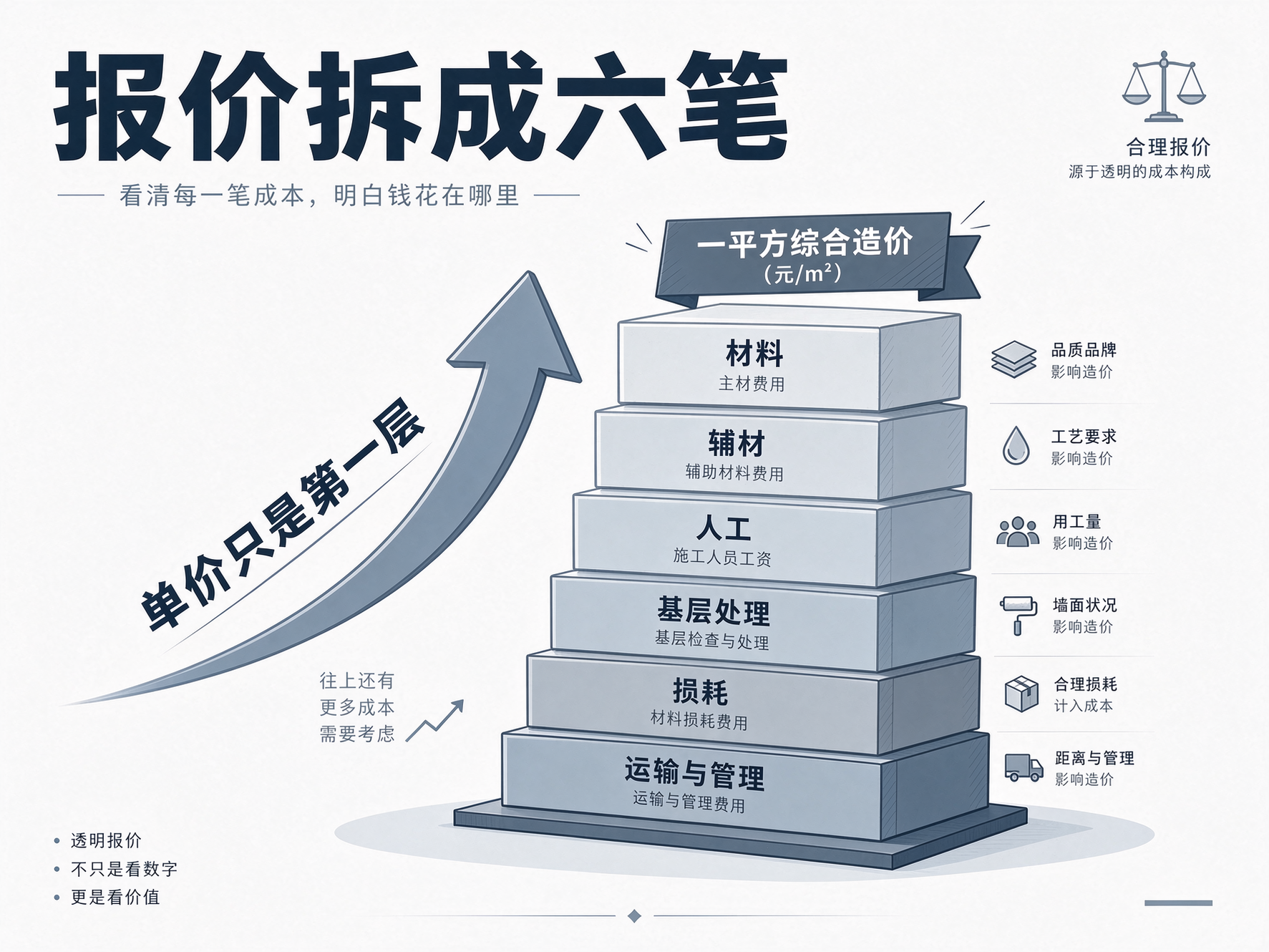
When a quotation is laid out, under normal circumstances six cost items should be visible: materials, auxiliary materials, labor, substrate treatment, loss, and transportation and management. Below, each item is explained clearly: what each cost item covers and how it is calculated.
The first item: materials
Refers to the sheet itself. Its pricing unit is square meters, but the actual usage must be converted based on the panel size after layout, not the net wall area. Its share of the total price is usually not the highest—this is exactly the opposite of natural stone.
The second cost: auxiliary materials
Adhesives, primers, pointing agents, corner guards and edge trims. This amount is not large, but it is the key to whether the whole system can hold up. The brand and model of auxiliary materials must be written into the quotation; writing only the three words "special adhesive" is as good as writing nothing. The auxiliary material reports on this site can be cross-referenced: one-component soft porcelain adhesive JXT2026SD223120209 (Report page), liquid soft porcelain adhesive JXT2026SD223120208 (Report page), grout JXT2026SD223120212 (Report page)。
The third cost: labor
Labor for the installation system includes cooperation in substrate acceptance, adhesive application, installation, joint alignment, pointing and cleaning. Labor cost is directly related to three factors: wall height (whether scaffolding or aerial work platforms are needed), proportion of irregular shapes (the more corners, columns and openings, the slower the work), and schedule tightness (crashing the schedule requires more workers, and more workers means more cost). For the same area, if the proportion of irregular shapes doubles, labor may more than double.
The fourth item: substrate treatment
This item is the easiest to miss and the easiest to add during construction. Substrate preparation includes: repair of hollow and dusting areas, leveling for flatness, correction of internal and external corners, moisture content treatment, and interface treatment when necessary. The criterion is not "it looks flat," but checking with a straightedge and side lighting. If an unqualified substrate is installed on the wall, all subsequent hollowing and waviness will be blamed on the material.
The fifth item: loss
The loss rate depends on the layout, not on whether the material is good or bad. Arrange by panel size and cut irregular pieces from offcuts, and the loss can be kept very low; cut at will without regard to panel size, and the loss will rise noticeably. This item is usually calculated as a percentage in the quotation, and what the owner should ask is "what layout is this percentage calculated from?"
The sixth item: transportation and management
Including freight, loading and unloading, carrying upstairs, on-site protection, project management, and warranty services. The difference between cross-province projects and local projects lies mainly in this item. Export projects also require customs declaration, packaging (wooden crates or pallets), ocean freight, and destination port delivery terms; this part can go through Contact page Confirm separately.
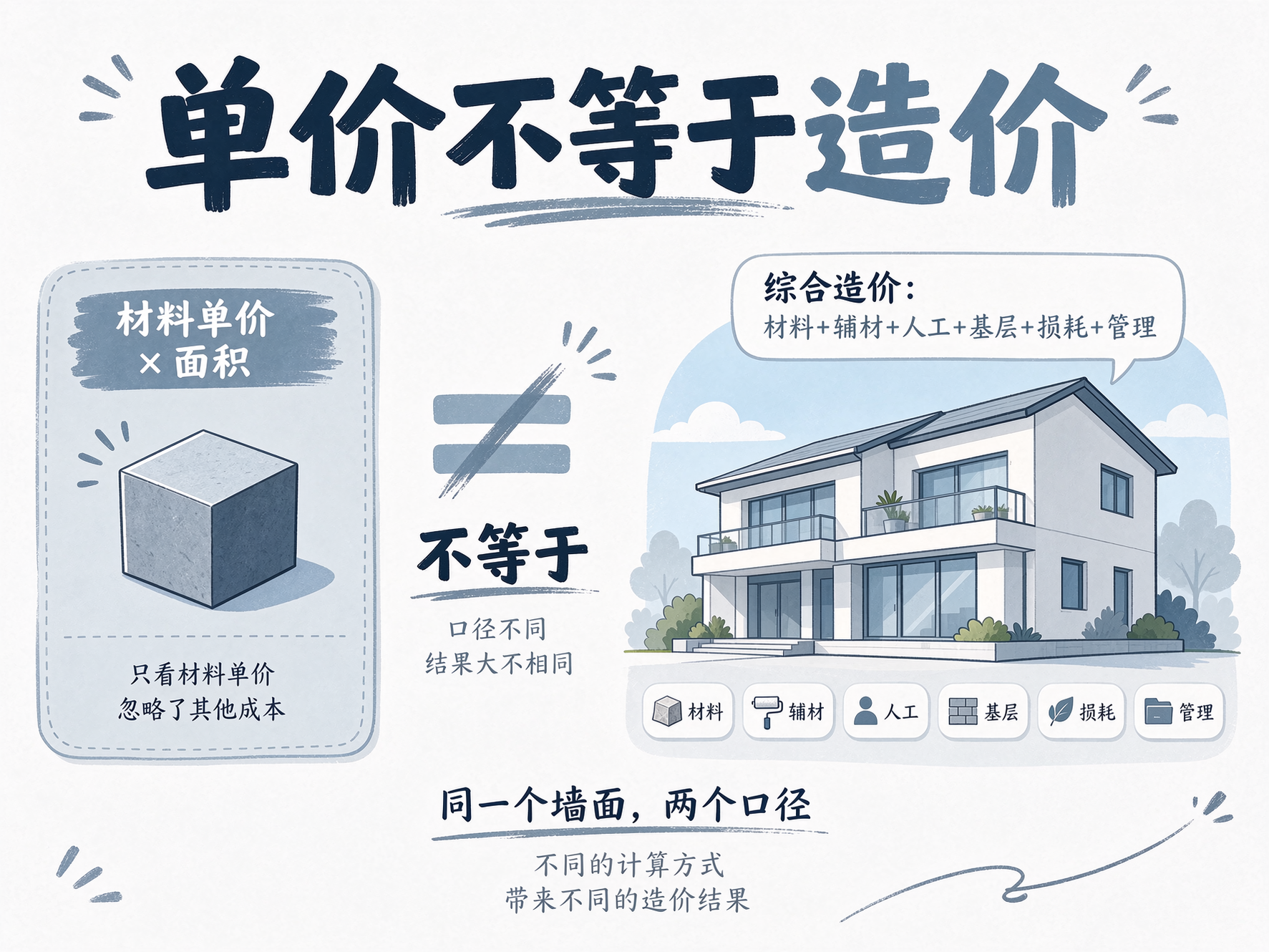
III. Unit price is not the same as cost: do not mix up the two calibers
This is the most common mismatch in quotation communication. When the owner asks "how much per square meter," they usually mean "unit price of materials"; when the contractor quotes "how much per square meter," they usually mean "comprehensive unit price including auxiliary materials and labor"; and what actually goes into the budget table is "comprehensive cost including substrate, wastage, and management." With three different bases mixed together, no amount of discussion will reach agreement.
It is recommended to state the basis clearly at the quotation stage, resolving it in three lines:
- Material unit price: refers only to the sheet material, calculated per square meter, excluding auxiliary materials and labor.
- Comprehensive unit price: includes materials, auxiliary materials and labor; excludes substrate treatment and waste.
- Comprehensive cost: includes materials, auxiliary materials, labor, substrate treatment, waste, transportation and management, i.e. the final settlement basis.
For the same wall, these three figures may differ greatly. Aligning the scope before discussing price is much more effective than bargaining. For a more complete full-cycle perspective, see Full life-cycle cost In another article, maintenance and renovation are also included in the calculation.
IV. Compared with stone-look coatings, the comparison is not about unit price
Many people compare the price of flexible stone with stone-like coatings. This comparison itself is reasonable, but the method of comparison is often wrong. The correct comparison is in three dimensions:
- Initial investment.The material plus labor cost of coating is usually lower, and the construction period is also shorter; this is its real advantage.
- Construction and service life.Coating is a coating layer attached to the substrate surface; sheet material is a finish layer with a defined thickness and independent physical properties. The durability logic of the two differs, and so do the acceptance standards.
- Renovation cost.Paint renovation is usually a recoat: short cycle, low unit price, but possibly higher frequency; sheet renovation involves removing the finish layer, re-leveling and bonding, with high one-time cost and low frequency. Determining which is more cost-effective depends on how often the space is renovated.
So the answer to "which is cheaper" depends on the service life. In the short term, look at the coating; in the long term, look at the system—this is not a bias toward either side, but rather that the cost curves of the two materials have different shapes.
V. The dedicated adhesive: this item cannot be omitted
The auxiliary material most likely to be subjected to price pressure is the adhesive. To control unit prices, some projects substitute ordinary tile adhesive or general-purpose adhesive for the dedicated adhesive. Problems may not show in the short term but begin to appear in the medium term: hollowing, edge lifting, joint cracking, and the final rework cost far exceeds the initial savings. The reason is not complicated—flexible stone is a thin sheet, and its deformation characteristics are completely different from ceramic tile; the matching adhesive is designed for this system in terms of flexibility, open time and water absorption matching.
For this item, the quotation should specify three things: the brand and model, the application rate (kg/㎡), and the relevant test report number. The auxiliary-material report numbers available on this website are listed in the second section above for reference. A quotation that merely states “some special-purpose adhesive” without specifying the model or providing a report warrants further questions.
VI. The three things most easily overlooked in 2026 quotations
- The proportion of labor is rising.The installation system is a labor-intensive process, with labor accounting for a higher share than materials. If negotiations only press down material prices, then beyond a certain point the contractor can only cut labor, and ultimately construction quality suffers.
- The acceptance criteria determine the probability of rework.If the criteria for judging flatness, joint width, color difference and hollowing are not clearly specified before work starts, there will be room for dispute at the acceptance stage, and rework costs will appear in the form of "additional items". On-site Common Questions section There are articles specifically covering acceptance inspection items.
- For custom products, allow sufficient time for sampling and production.For printed custom finishes (inorganic ink printing series), the pattern and color code must be confirmed before scheduling production;2026 new models The delivery time also differs from that of the regular model. For projects with tight schedules, including the sampling cycle in the plan is more important than pressing for a lower price.
VII. The same material, three projects, three different quotations
The six components form the same structure, but the proportion of each component differs completely from project to project. Looking at three typical projects together makes the source of the price differences very clear.
New hotel lobby.The substrate is new plaster, so conditions are relatively controllable, and the fourth item (substrate treatment) accounts for a medium proportion; however, the area is large, there are many columns and many irregular shapes, so the third item (labor) accounts for a high proportion; the schedule is constrained by the opening date, and rush work is likely. In the quotation for this type of project, labor and layout waste are the main variables, while materials are not.
Chain stores and storefronts.Individual stores are small, but there are many stores and delivery locations are scattered, so the proportion of the sixth item (transport and management) rises noticeably; scaffold and high-altitude work must also be considered for the storefront position. The optimization direction for such projects is not to push down unit prices, but to unify color codes, unify layout modules and place centralized orders, so that waste and management costs are spread thinner.
Old building renovation.The proportion of the first and second items decreases, and the fourth item (substrate treatment) becomes the largest variable. Hollowing, dusting, oil contamination, and the adhesion of the original coating on old walls all directly change the method: for what can be covered directly versus what must be stripped and redone, the quotation may differ by a factor of two. This is also the most common reason renovation projects see "extra charges after work begins"—what is added is not materials, but the substrate. On-site Renovation Cases and Flexible split brick installation method The different approaches to substrate preparation can be compared.
So before comparing two quotations, first confirm whether they are for the same type of project. Using the unit price of a new-build project to benchmark a renovation project, or the reverse, is an invalid comparison.
VIII. How to Obtain a Quotation That Can Be Compared
If three quotations are received at the same time and their criteria differ, price comparison is a waste of effort. To make quotations comparable, provide these seven conditions at once when inquiring:
- The city where the project is located and the floor level, and whether scaffolding or a lift platform is needed.
- Construction area: net wall area, irregular-shaped area, number and diameter of columns.
- Current substrate condition: new plaster, old wall, or substrate board; attach site photos.
- intended style and thickness, and whether substitution within the same series is permitted.
- Whether special documentation such as fireproofing and moisture-proofing is needed, and which standard acceptance should follow.
- Construction period: site entry time and closing nodes.
- Delivery method: whether shipping is included, upstairs delivery, packaging standards, and whether delivery is in batches.
Only when all seven items are provided in full can a quotation be compared item by item. If they are incomplete, all you are comparing is three lump-sum totals—choosing any one of them is a gamble.
IX. A realistic order of judgment
Finally, here is a set of decision steps you can use directly; follow them, and the price issue will become a manageable issue:
- First define the basis: do you want the material unit price, the all-in unit price, or the all-in cost?
- Then determine the layout: how the panels are arranged, how much waste there is, and where material for irregular shapes is taken from.
- Then determine the substrate: what the current condition is, whether leveling is needed, and who is responsible for leveling.
- Then determine the auxiliary materials: write the model, dosage and report number into the quotation.
- Final price negotiation: it only makes sense to negotiate when the specifications and conditions are consistent.
If this project is still in the selection stage, you can first look at Flexible stone product page With the sub-series page (Travertine、Slate、Rammed earth panels、Split-face brick) Confirm the style direction, then request a quote according to the seven conditions above; renovation projects can refer directly to Renovation Split-Face Brick Application Plan the substrate practices for this type of project, whose cost structure differs greatly from that of new-build projects; the same quotation cannot be applied.
Price is never a matter of the lower the better; rather, it is "under the same criteria, whose solution is less likely to require rework." The cost of one rework is usually much greater than the price difference of one quotation.



 WhatsApp

 Guangdong Public Network Security Preparation No. 44200002005257
