

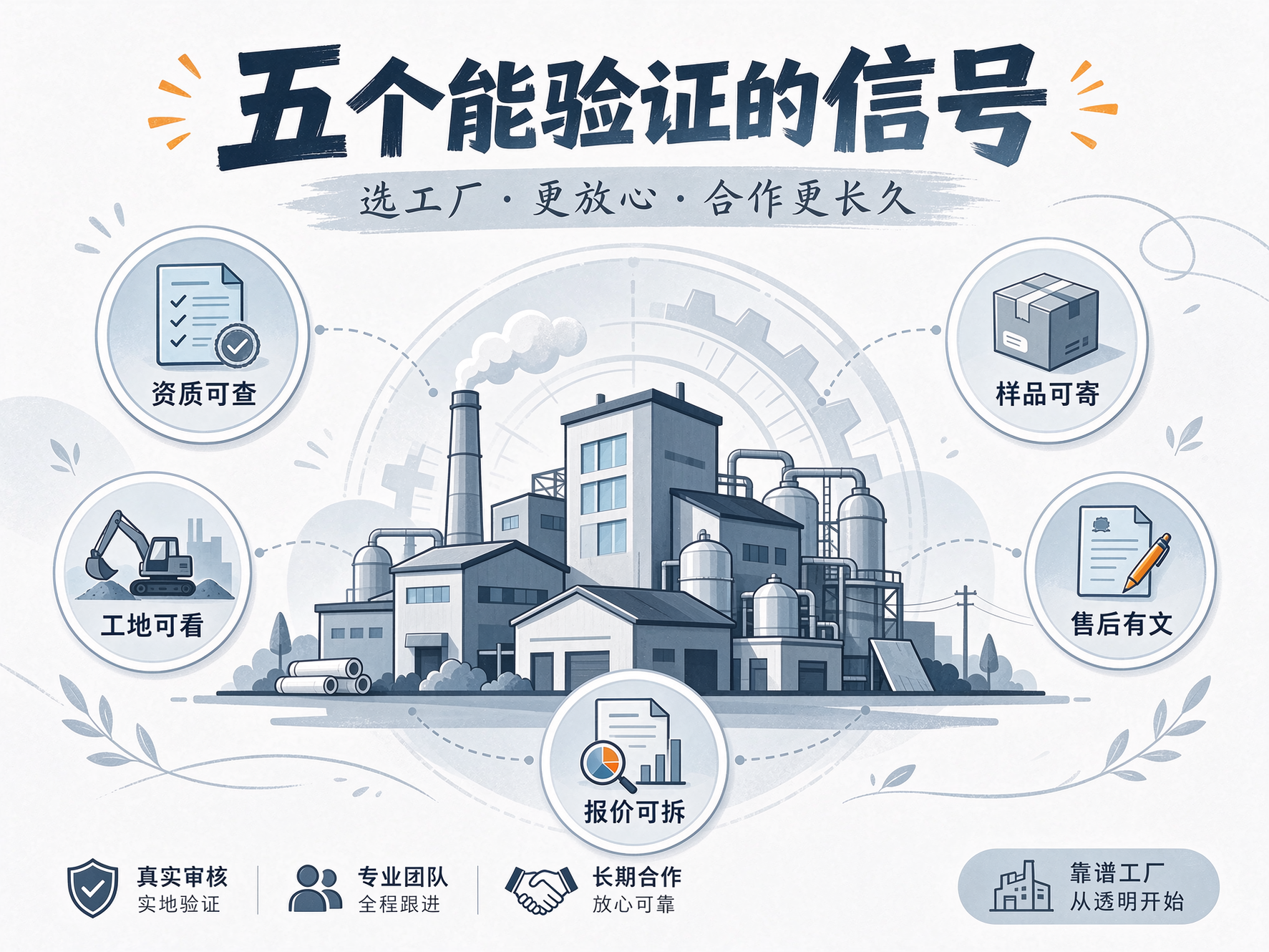
Conclusion first:When choosing a flexible stone manufacturer, don't listen to phrases like "strong capabilities and industry-leading." Look at five verifiable signals: qualifications can be checked, samples can be sent, job sites can be visited, after-sales terms are documented, and quotations can be broken down. Only when three or more of the five can be verified is it worth entering substantive negotiations; if none can be verified, no matter how low the price, you should not sign.
First: Where does the information asymmetry in this industry lie
Flexible stone (soft porcelain) is a product of formulation plus process. Its appearance can be replicated by molds, and its texture can be imitated by printing, but performance such as weather resistance, flexibility, and stain resistance depends on the formulation system and the sintering/forming process; appearance alone cannot reveal this.
This means: for the same texture, there may be three vendors selling it on the market, with prices differing by a factor of two, and the photos look the same. The difference shows up three years later—one vendor's wall starts to effloresce and curl at the edges, while the other's still sits quietly. So choosing a manufacturer is essentially choosing "the one that still holds up three years later," not "the one whose photos look most alike."
There is only one way to break through information asymmetry: replace "unverifiable statements" with "verifiable actions." The five signals below are five actions that can be verified.
II. Signal one: qualifications can be verified
The question is not "Is there a certification?" but "What is the number, so I can check it myself?" Verifiable qualifications generally fall into three categories:
- System category.ISO9001 quality management system and ISO14001 environmental management system; the certificate numbers and certification bodies must match.
- Safety category.Combustion performance test report and hazardous substances limit test report. For exterior wall and public space projects, these two are hard thresholds.
- Environmental category.Test reports such as those for formaldehyde and heavy metal element migration will be checked for school, hospital and hotel projects.
The publicly searchable numbers on this site include: combustion performance WT2024B03A00139 (Report page), hazardous substances limits WT2023B01A06057 (Report page), SGS formaldehyde and elemental migration GZIN2610002141CM01_EN (Report page), SGS lead and cadmium GZIN2610002141CM05_EN (Report page), JXT2026SD223120213 (Report page), DER25T0008863 (Report page). There are three additional auxiliary materials: adhesive JXT2026SD223120209, adhesive JXT2026SD223120208, and grout JXT2026SD223120212.
Key points for judgment: the report must correspond to a "specific model", not "a certain product"; the report must have a validity period and a testing institution; auxiliary material reports and main material reports must form a complete set. A supplier with only main material reports and no auxiliary material reports has an incomplete system.
III. Signal two: samples can be sent
Samples are the cheapest means of verification, and also the step most easily glossed over. Require three things to be clearly stated:
- Same batch.Samples must be from the same batch or same formulation as the bulk goods; they cannot be "specially made display samples."
- Can be kept on file.Samples must serve as a basis for later comparison; preferably in duplicate, with one copy sent to the customer and one kept on file by the manufacturer.
- Destructive testing can be performed.Are customers allowed to bend, soak and wipe it themselves? Manufacturers that allow this usually have confidence in their formulation.
Practical approach: after receiving the sample, do a "three-minute test" yourself—wrap it around a small-diameter cylinder to see whether it cracks, drip a few drops of water on it to see whether it penetrates, and wipe it a few times with a damp cloth to see whether the color comes off. Only after all three pass should you discuss price.
IV. Signal three: the site can be seen
Case photos are the easiest material to fake: renderings, stock images, and photos of other people's job sites can all be put into a brochure. A verifiable case has three characteristics:
- Can be present on site.Provide the project name, city, and approximate location, and allow customers to visit in person.
- There is time.You can clearly state which year it was done, and you can see its condition after several years.
- There are details.Can provide detail construction methods, construction difficulties, and how they were handled at the time, rather than just a panoramic photo.
Of these three, "has time" is the most valuable—a project that has been in place for three years and one just completed are in completely different states. The point of looking at cases is not "does it look good," but "how much is left after three years."
The cases on this site are categorized by scenario, available for reference Case overviewaccording to Old renovation and Hotel commercial Look at the two first, because they best show "the condition after several years of use"; for specific solutions, see Hotel travertine plan and Renovation Split-Face Brick PlanThe site's position on actual product photos is clear: actual photos are used to explain the material itself and are not treated as completed project cases; for exterior walls, damp areas, or special acceptance locations, test data, substrates, bonding systems, and detail methods should be checked separately.
V. Signal four: after-sales has documentation
"Contact me anytime if there's a problem" is not after-sales service; it is a verbal promise. Enforceable after-sales service must be documented:
- Warranty terms.Clearly state what is covered, for how long, and under what circumstances it is not covered. The warranty for thin-sheet finishes usually distinguishes between "material performance" and "installation quality," and the responsible parties for the two are different.
- Construction briefing.Can you provide written technical disclosure: substrate requirements, supporting auxiliary materials, key process steps, and curing period? Manufacturers willing to issue technical disclosure are usually also willing to bear technical responsibility.
- Technical support.For large wall areas, irregular shapes and exterior wall projects, can personnel be sent on site or provide remote support? This item is most valuable when problems arise.
- Replenishment commitment.Whether later replenishment can guarantee the same color number and the same batch, and how long delivery takes. For hotel and chain project renovations, this determines whether the replenishment can be "seamless."
Of the four items, the most easily overlooked is the "replenishment commitment." It doesn't affect signing the order, but it affects maintenance costs three years later.
VI. Signal five: quotations can be broken down
Whether a quotation can be broken down is the fastest way to judge a supplier's professionalism. A breakdown quotation should have at least four parts:
- Material cost.By square meter or by piece, indicating specification, thickness and model.
- Auxiliary material cost.Adhesive, grout, primer, and edge trim, priced by usage or by linear meter.
- Construction fee.By square meter, stating whether substrate treatment is included and whether special-shape surcharges are included.
- Loss and transportation.Loss rate, transport method, unloading responsibility.
A quote that gives only a "comprehensive unit price" will definitely add money at some stage later—usually for substrate treatment, special-shape surcharges, and auxiliary materials. For a complete quote breakdown method, refer to 2026 quotation six items breakdown and Full life-cycle cost。
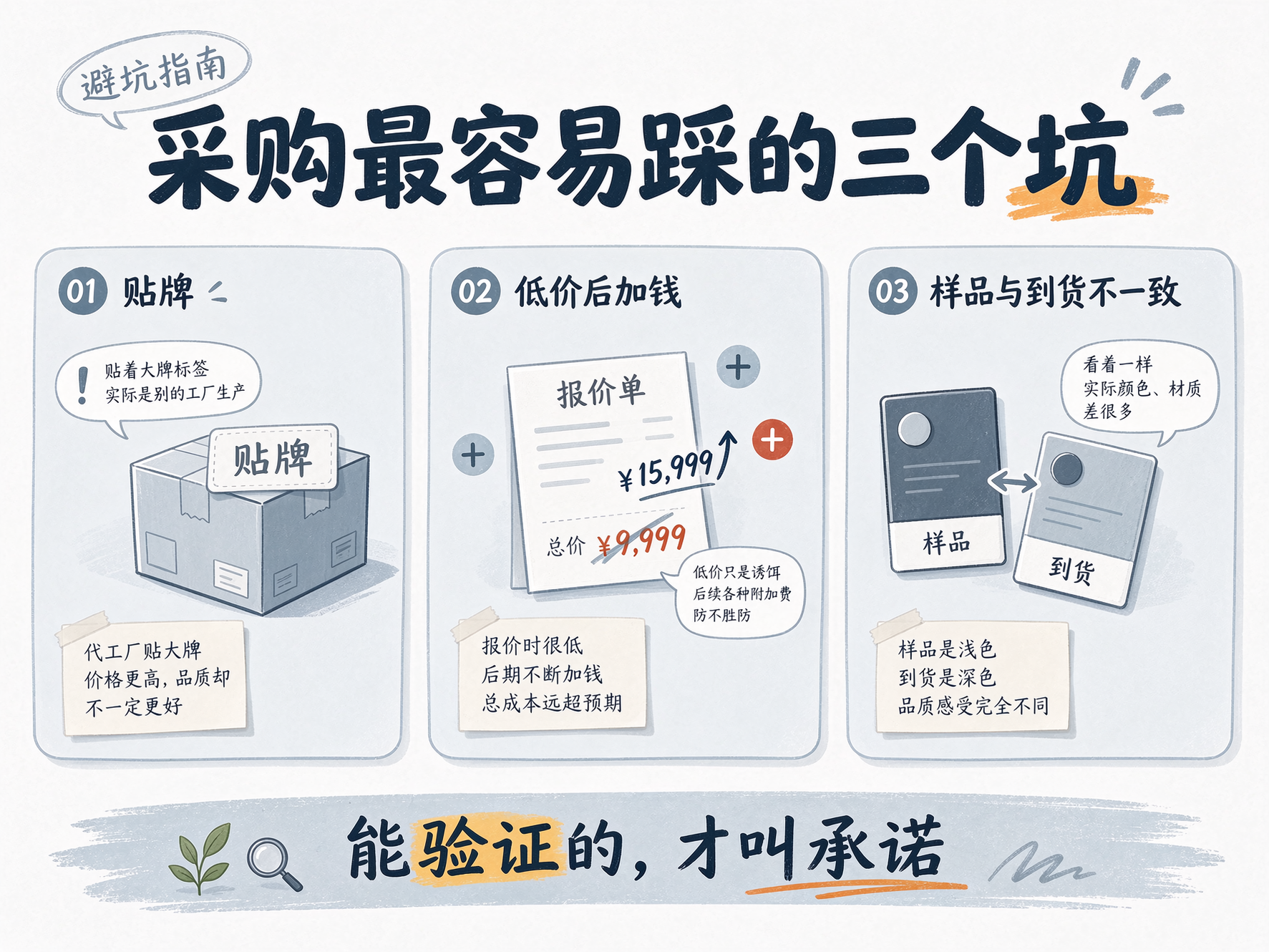
VII. The three most common pitfalls
Pitfall one: OEM labeling.The packaging shows a well-known brand, but the product is actually OEM-produced by another factory, and performance does not match the claims. Identification method: ask for the production address, visit the factory, and check that the client name on the report matches the business license.
Pitfall Two: A low price followed by added charges.If the first-round quote is noticeably lower than competitors', after entering the site they add charges item by item with "the substrate is too poor and needs treatment", "special shapes require a surcharge" and "auxiliary materials not included", and the final total price ends up higher. How to identify: require all cost items to be listed at once and written into the contract.
Pitfall three: samples inconsistent with delivered goods.The sample color, texture and thickness are all correct, but the goods delivered are not. Identification methods: retain and seal samples, agree on comparison standards, and conduct incoming inspection with evidence retained. If this is not written into the contract, there is almost no room for negotiation when a problem arises.
VIII. Inspection Route: Three Questions from Afar, Four Observations at the Factory
When time is limited, this order is the most efficient way to proceed:
Three questions for remote review.First, ask for the report number (can it be self-checked); second, ask for the case address (can you visit the site); third, ask about the quotation structure (can it be broken down into four parts). If two of the three questions are vague, the conversation can basically be ended.
Four checks upon arrival at the factory.First, see whether the production line is running (not just for show); second, look at raw material and formula management (whether there are batch records); third, look at retained samples and quality inspection (whether there are archived sample boards and spot-check records); fourth, look at the finished goods warehouse (inventory and shipping capability). Among these four, "retained samples and quality inspection" best demonstrates the level of management.
IX. Five must-ask questions
- Which test report does this model correspond to? What is the number? Can I check it myself?
- Are samples and bulk goods from the same batch? Can replenishment guarantee the same color code?
- Can you give me the address of a project that has been in place for three years?
- Are the auxiliary materials matched? Are all three reports complete?
- Can the quotation be broken down into four parts: materials, auxiliary materials, construction and loss?
The answers to the five questions can basically outline a supplier's true level. Those who answer clearly are not necessarily the best; those who cannot answer clearly definitely have problems.
X. Three Common Questions
Q: Is a larger manufacturer always better?Scale determines capacity and stability, but not suitability. What a project needs is "this model, this batch, this delivery date." A large scale that cannot be scheduled is less useful than a moderate scale with controllable delivery.
Q: The price is half as much—can it be trusted?See where the price is low. It can be low in formulation (high filler ratio), low in thickness (nominal 3mm but actually 2mm), or low in auxiliary materials (not matched), and any of these can achieve "half the price." Ask the other party to explain "why it can be lower"; if they cannot explain clearly, that is a risk.
Q: Is a factory visit really necessary?For large, long-term cooperation, it is advisable to go; for a single project with small batches, "three remote questions + sample testing + case verification" can be used instead. In any case, however, the report number and the case address must be verifiable.
XI. Different Procurement Roles Require Different Considerations
The five signals are universal, but different roles prioritize them differently. Explain clearly by four types of buyers:
Decoration companies and designers.Prioritize looking at "texture integrity" and "achievable details." What designers want is whether the effect can be realized: whether curved surfaces can be wrapped, how internal and external corners are finished, and how joints with metal and wood veneer are handled. Therefore, samples and detail drawings are more important than price, and report numbers are the entry ticket.
Engineering contractor.Prioritize looking at "lead time, batch consistency, and supporting auxiliary materials." The contractor's risk lies in schedules and rework: one batch with color variation may cause an entire wall to be redone; one instance of auxiliary materials not matching may cause the entire system to fail. Therefore, being able to break down quotations and guarantee replenishment is far more important than a unit price that is a few yuan lower.
Building materials foreign trade company.Prioritize looking at "completeness of documentation and export suitability." Overseas customers will check test reports, ask about packaging and container loading, and require consistency. SGS-type reports, combustion performance reports, and hazardous substance reports are the threshold for entering the other party's supply chain, not a bonus.
Channel partners and building-materials business owners.Prioritize looking at "the ability to fill product line gaps and sell-through support." What channels want is not a single model, but a line that can fill gaps in existing products: the high-end segment where tiles do not sell, and the curved-surface segment that stone cannot handle. At this point, what matters is series breadth (more than ten series such as travertine, slate, rammed earth panels, fabric-textured stone, artistic soft porcelain, gilded panels, translucent stone, and newly quarried stone,Product page a complete list), as well as the minimum order quantity, sample support and replenishment rhythm.
The judgment order differs for the four types of identity, but the conclusion logic is consistent: first verify "whether it can be delivered," then discuss "whether it's worth it." If the order is reversed, cheap becomes a risk.
Add one more practical suggestion: turn the five signals into a one-page evaluation form, with the signals in the left column and "what the other party provides" and "what I verified" in the right column. Talk to three suppliers and fill out three forms; a horizontal comparison makes it clear at a glance who is evading and who is providing evidence. Judgment does not require talent; all it requires is turning words into records.
One more criterion that is often overlooked: whether the other party is willing to proactively clarify where the product is "not applicable." Flexible stone cannot be used for floors, areas subject to long-term water immersion, or structural load-bearing components. A supplier willing to explain the boundaries clearly is usually not vague in other areas either. Those who agree to everything and claim to do everything often only start explaining the conditions at the time of delivery.
XII. Next steps
To put these five signals into practice, the most efficient order is: first request three report numbers (main material, combustion performance, auxiliary materials), then request the address of a case that can be visited on site, and finally request a quotation that can be broken down into four parts. Once all three are in hand, the assessment is essentially complete. For product series, see Flexible stone、Travertine、Artistic soft porcelain; for a summary of qualifications, see Qualifications and reports page; to verify materials and auxiliary materials per project, go to Contact pageGuangdong Fulaite Building Materials Co., Ltd. (brand FLAT Fulaite, Zhongshan production base).
In the end, choosing a manufacturer is not about who talks the best, but about who is willing to turn words into something you can verify.



 WhatsApp

 Guangdong Public Network Security Preparation No. 44200002005257
