

Conclusion first:Flexible stone (MCM soft stone/soft porcelain) isWall materials, it is not a flooring material. Five types of wall surfaces can be evaluated: hotel lobbies, dining and tea spaces, clubs and beauty spaces, chain stores and storefronts, and building exterior walls; do not use it in three places: floor paving, areas subject to long-term water immersion, and components requiring structural load-bearing.
I. First, distinguish between "looks like stone" and "is stone"
The formal industry name for flexible stone is MCM (modified inorganic powder composite building facing sheet). The product system on this site is uniformly called flexible stone, also known as soft stone or soft porcelain. Its raw materials are mainly inorganic mineral powders, made into sheets through mixing, forming, drying and composite processes. The logic of making the finished product is not "cutting stone thin" but "using powder to create the surface of stone"—so it is inherently thin, inherently light and inherently bendable. This process starting point determines all of its subsequent performance boundaries and also determines that it is not the same type of component as natural stone.
Guangdong Fulaite Building Materials Co., Ltd. (brand FLAT Fulaite, Zhongshan production base) on the site Flexible stone product page The standard specifications given are these six:
- Common specification 1200×2400mm, can be cut to project dimensions.
- Thickness 2–5mm; 3mm is commonly used in commercial projects.
- Weight is approximately 3–7kg/㎡, varying with thickness and backing.
- The form is bendable; cylindrical columns, curved walls, and irregular corners can be wrapped in a single piece.
- Surfaces are divided into series by style:Travertine、Slate、Flamed granite、Rammed earth panels、Cloth-texture stone、Artistic soft porcelain、Split-face brick。
- The construction method is adhesive bonding after leveling, without relying on a dry-hanging keel system.
Among these six items, the most important are the second, third and sixth. Thin and light means low load and structural friendliness; adhesive bonding means that "whether it can go on the wall" is left to the substrate and the bonding system, not to a steel frame. So to judge whether a location can use it, the real questions to ask are three: Is this location a wall surface, can the substrate be leveled, and can the bonding system withstand this environment.

II. Five types of spaces that can be assessed
1. Hotel lobbies and reception areas
The conflicts in a lobby are usually very specific: you want texture, you want to meet the schedule, and you want to control the total cost. Dry-hanging natural stone requires a steel frame, a stone-processing cycle and hoisting coordination; a single reception feature wall often involves work on four sides. Flexible stone weighs an order of magnitude less for the same area; the substrate only needs plastering and leveling, and with the dedicated adhesive it is applied directly to the wall, greatly shortening the process chain. Three types of locations in the lobby suit it best: the large surface of the reception feature wall, cylindrical and curved columns, and walls such as elevator halls that are "small in area but visually highly prominent." To look at it by location, you can first read the on-site Hotel travertine wall application plan。
2. Restaurants, cafés and tea spaces
Walls in spaces like this share a common trait: the area is not large, the renovation frequency is high, and the style must change along with the menu and the customer base. With natural stone, any change means demolishing the wall; with flexible stone, as long as the substrate of the old wall is still sound, it can be sanded and leveled and then covered directly, and the renovation cycle is measured in days rather than weeks. Rammed earth panels, fabric-textured stone and slate are the most used in this kind of space that "wants texture, not too much gloss"; combined with lighting, they can create layering.
3. Clubs, beauty and wellness spaces
Spaces like this place higher demands on "tactile feel" and "the absence of a cold sensation" than on appearance. Natural stone feels cold to the touch, whereas the surface temperature of flexible stone is close to that of the indoor environment, so leaning against it is not jarring. Another practical reason is the many corners and curves—beauty bed areas, partitions, curved booth seating; with hard materials, either the seams look bad or custom fabrication is required. What bendable sheets save in these locations is not just money, but also the wrangling over termination details.
4. Chain stores and storefronts
What chain brands care about most is that "store No. 20 looks the same as store No. 1." Natural stone is a natural product; even different batches from the same quarry have color differences, making it difficult to maintain consistency when opening stores across regions. Flexible stone is industrially produced, so color codes can be locked and restocking can match batches. For facade signage locations, self-weight and installation conditions must also be considered; lightweight panels are friendlier to existing buildings. For projects with high brand visual requirements, you can look at Retail space printed finish solutionIt uses the inorganic ink printing series, and patterns can be printed directly onto the sheet.
5. Building exterior walls and old renovation
Exterior walls are the category with the highest threshold among these five, and also the one asked about most. Whether it can be used depends on four things: local wind load and substrate strength, compatibility of the bonding system, waterproofing at nodes, and the acceptance standard that this project must meet. The self-weight advantage of flexible stone is especially obvious in old-building renovation—adding dry-hung stone to an old building requires recalculating loads, while the load increment of bonded lightweight sheets is much smaller. On-site Renovation Cases There is a full-surface coverage approach; the fire protection aspect can be cross-referenced with Exterior wall fire protection boundaries In another article, it explains in more detail "under what conditions it can be used and under what conditions the plan must be changed."
III. Three boundaries where it should not be used
Clearly stating what is not applicable is more valuable than beautifully stating what is applicable. The following three situations are not recommended for flexible stone no matter how urgent the project is:
- Ground paving.Flexible stone is positioned by design as a wall finish; abrasion resistance, compressive resistance, and impact resistance are not its strengths. Floors must withstand continuous foot traffic, furniture movement, and equipment loads, and such stress conditions exceed the load-bearing logic of a sheet plus adhesive layer. For floors, please select dedicated flooring materials such as stone, ceramic tile, or resilient flooring.
- Areas subject to long-term water immersion.The inner walls of water tanks, areas around swimming pools subject to long-term standing water, and substrates that are damp for long periods with poor ventilation will all keep the bonding layer in a water-containing state for a long time. If such areas are to be treated, the waterproofing layer and drainage must first be addressed, and then the bonding system must be evaluated separately; the practices used for ordinary walls cannot be applied.
- Components requiring structural load-bearing.It is not a structural material. Load-bearing wall reinforcement, structural strengthening, and any part that needs to participate in load bearing are outside its scope of application. The sheet material only performs a finish function; loads and structural safety are the responsibility of the main structure.
The product pages on the site clearly state this boundary: for external walls, damp areas, or locations with special acceptance requirements, the test data for the specific model, the substrate, the bonding system, and the detail work must be checked separately; product photos also do not represent a commitment of suitability for all service conditions. This is not boilerplate disclaimer language—it describes a working method: define the conditions first, then determine the material.
IV. Advantages must be specific to hold up
- Load is small.At a magnitude of 3–7kg/㎡, this is not on the same level as dry-hung stone systems at tens of kilograms per square meter, making the load calculations for renovation and high-rise exterior walls much easier.
- Thin, it does not occupy clear height.2–5mm sheets plus a bonding layer; the thickness is far smaller than the keel space of a dry-hanging system, so considerable dimensions can be saved in areas with tight clear dimensions such as corridors and elevator lobbies.
- It can bend, with few closures.Cylinders, curved walls, and irregular corners can transition as a single piece, reducing the seams that hard materials must address through multiple-piece splicing and metal edge trim.
- The process is short.The three steps of leveling, bonding and pointing are the main ones. No steel frame welding and no hoisting coordination are required. Compressing the construction period is a rigid benefit in chain store openings and hotel renovations.
V. Limitations must also be clearly stated
- Sensitive to substrate flatness.The upper limit of flatness for the adhesive system is determined by the substrate; if the substrate is uneven, the sheets will follow suit, and such defects will be magnified under side lighting.
- Seams will expose the layout.If layout planning is not done for large wall areas, the joints will look fragmented; styles with a high texture repetition rate also need advance layout planning on very large surfaces.
- Not resistant to sharp impact.When thin sheet materials are hit by hard objects or struck by scaffolding, the damage is local, but repairs must use the same batch color number.
- Cannot replace structural materials.This was already mentioned earlier, but it is the root of all misuse and is worth emphasizing once more.
Of these four limitations, the first two can be solved through construction and design, while the last two are determined by material properties. Judging whether a project is worth using comes down to judging "whether these two can be kept under control."
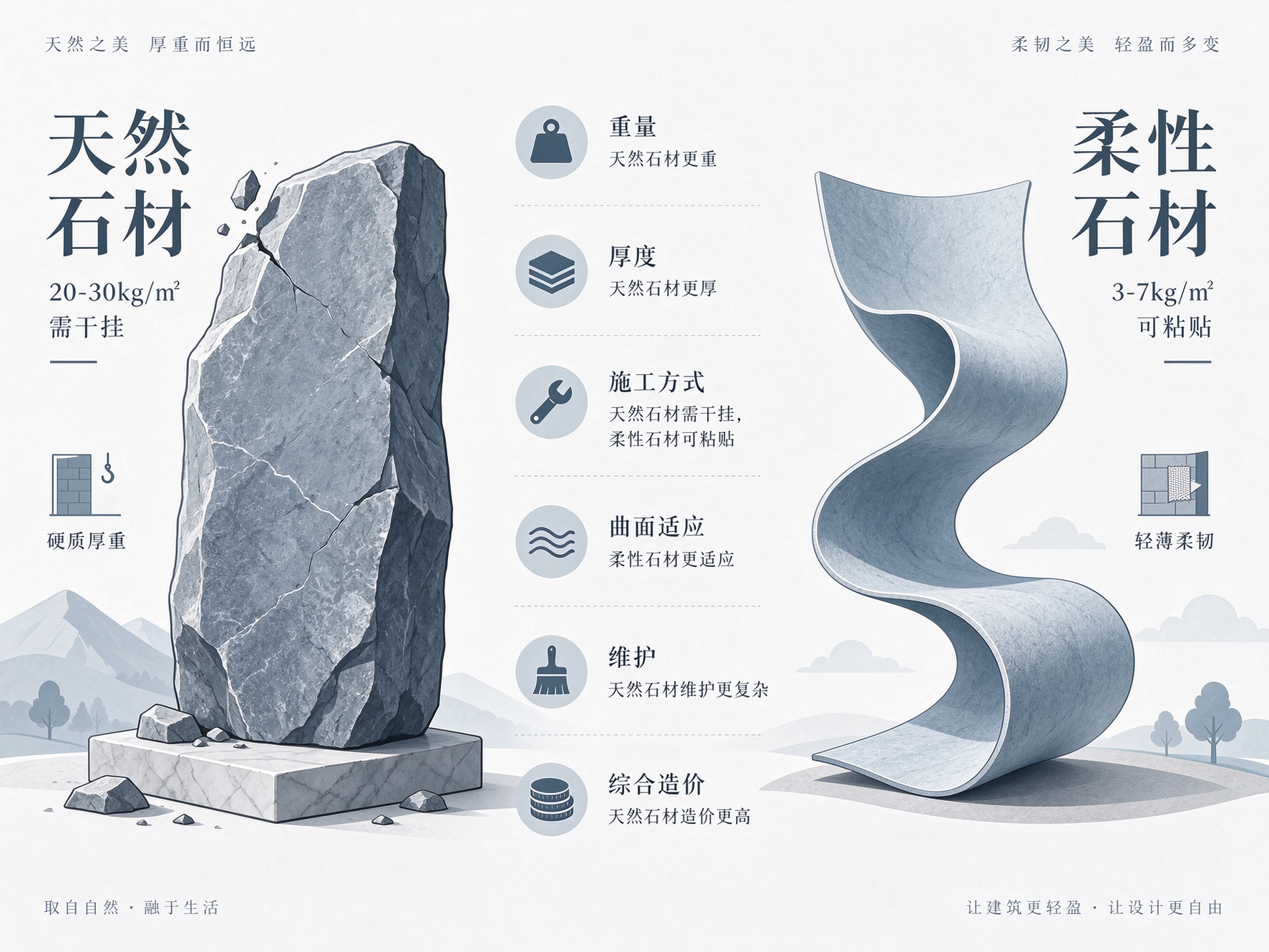
VI. Six differences from ordinary stone
The question many designers have on first contact is "how exactly is it different from stone?" The answer is not in whether the texture looks alike, but in the following six points:
- Weight.Natural stone is on the order of 20–30kg/㎡ and requires dry-hanging; flexible stone is 3–7kg/㎡ and can be adhered.
- Thickness and construction.Stone is a cavity system of thick slabs plus a metal frame; flexible stone is a direct-bond system of thin sheets plus an adhesive layer.
- Construction method.Stone requires setting out, welding frames, hanging panels, and applying sealant; flexible stone requires substrate acceptance, adhesive application, bonding, and joint filling. The former is a steel-structure process, and the latter is a decoration process.
- Curved-surface adaptability.Stone cylinders must be cut, curved sections pieced together, and joints left; flexible stone wraps the whole surface in one piece, so the curved surface is continuous.
- Batch consistency.Natural stone is a natural product, and color differences exist between different batches from the same quarry; flexible stone is an industrial formula, so color codes can be locked and replenishment is possible.
- Cost structure.Stone is expensive in slabs, processing, metal frames, and hoisting; flexible stone is expensive in substrate treatment and labor, and the material itself is not a major cost item—this difference is in Full life-cycle cost A more complete breakdown is in another article.
VII. How to verify that it is not "a sticker"
This is the question the client should ask most. The basis for judgment is not whether the sample looks good, but whether there is verifiable third-party testing. The publicly available report pages on the site can be checked directly against the number:
- SGS report GZIN2610002141CM01_EN, covering formaldehyde and element migration, see Report page。
- SGS report GZIN2610002141CM05_EN, covering lead, cadmium and other heavy metals, see Report page。
- Combustion performance test WT2024B03A00139, see Report page; the specific grades and scope of application are subject to the original report.
- Hazardous substance limit testing WT2023B01A06057, see Report page。
- Product inspection JXT2026SD223120213, see Report page; there is also DER25T0008863, see Report page。
- Supporting auxiliary materials also have reports: one-component soft porcelain adhesive JXT2026SD223120209 (Report page), liquid soft porcelain adhesive JXT2026SD223120208 (Report page), grout JXT2026SD223120212 (Report page)。
Auxiliary material reports are easily overlooked, yet they are precisely the key to "whether it can bond firmly." Sheets and adhesives form one system; testing only the sheets and not the auxiliary materials is equivalent to testing only half. Regarding system certification, ISO 9001, ISO 14001 and related qualifications are summarized in Qualifications and reports page, those needed for bidding can be obtained together.
VIII. From Sample Selection to Wall Installation, Four Steps Are Enough
- Determine the location.First clarify whether it is an interior wall, exterior wall, or special-shaped part, how large the area is, and whether there are waterproofing and fire protection requirements. If the location cannot be determined, sample selection is empty talk.
- Determine the style and layout.Style determines the grain direction and joint logic, while layout determines whether the overall surface looks unified or fragmented. At this step, it is recommended to produce a layout drawing rather than deciding on site.
- Determine the substrate and bonding system.Substrate flatness, moisture content, supporting primer and adhesive must be confirmed according to project conditions and must not be applied across projects.
- Determine the acceptance criteria.The inspection methods and acceptance criteria for flatness, joint width, color difference and hollowing must be written into the pre-work briefing before work starts, rather than argued about after completion.
The order of these four steps cannot be reversed. On-site Common Questions section There are articles on construction and acceptance broken down by process; it is recommended to read the whole set before construction; if the project is overseas, customs clearance, packaging and delivery terms can go through Contact page Direct contact.
IX. Three common misunderstandings
Misconception One: Being bendable means it is soft, and being soft means it is not sturdy.Bendable refers to the sheet's ability to deform during installation, not its strength in the in-use state. Once installed on the wall, it is constrained jointly by the adhesive layer and the substrate; it is a rigid finish layer, not a soft pad.
Misconception Two: Being cheap means being low-end.Its cost structure is completely different from that of natural stone—what is saved is the panels, keels, and hoisting, while what is spent more on is substrate treatment and labor. In the same project, it is not necessarily the cheapest, but under constraints such as "old renovations cannot add load," "the schedule is only two weeks," and "a full curved surface is required," it is often the most feasible option.
Misconception Three: Since it imitates stone, the more similar the texture, the better.What matters more on a project is whether the color code is stable, whether replenishment can match, and whether the layout and joints run smoothly. Whether it looks alike is an aesthetic question; whether it is stable is a delivery question, and problems with the latter require rework.
X. Next Steps: How to Proceed
If you currently have a specific project in hand, the fastest path is: organize the location, area, photos of the current substrate condition and acceptance requirements into a one-page description, and send it together with the intended styles. We will provide selection and method recommendations based on the project conditions, along with the test data for the corresponding models. If you need to see the actual product, we can send samples first; if you need to see completed walls, you can browse by space type Engineering cases in the Hotels and commercial、Residential and community Category.
Material selection has never been about choosing "the best material," but about choosing "the solution least likely to go wrong at this location, on this substrate, under this construction schedule, and against this acceptance standard." Flexible stone has a very wide range of applications, but its boundaries are equally clear—write the boundaries down first, and everything that follows will go smoothly.



 WhatsApp

 Guangdong Public Network Security Preparation No. 44200002005257
