

Conclusion first:The "service life" of flexible stone is not a fixed number of years, but the product of three conditions—the material itself, the bonding system, and the service environment. The material itself determines the upper limit, the system determines the lower limit, and the environment determines the rate of degradation. So when asking "how many years can it be used," the correct question is "on what substrate, with what adhesive, and in what environment can it remain stable for how many years."
I. Why the very question "how many years" is problematic
In an engineering context, "service life" has at least three definitions; mixing them up means it can never be explained clearly:
- The lifespan of the material itself.Refers to the aging resistance of the sheet itself under laboratory conditions, measured by accelerated aging tests; the conclusion is a set of data, not a number of years.
- System lifespan.Refers to the actual service capability of the combination of "sheet + bonding layer + substrate." Failure of thin-sheet finishes rarely occurs within the sheet itself; it mostly occurs at the bonding interface and the substrate.
- Project service life.Refers to the number of years this wall can be accepted by the acceptance party in a specific project. It is jointly defined by the design service life, warranty terms, and acceptance standards; it is contract language, not a material parameter.
Only by separating these three scopes can the question be answered. They are addressed separately below.
II. Three legs: material, system, environment
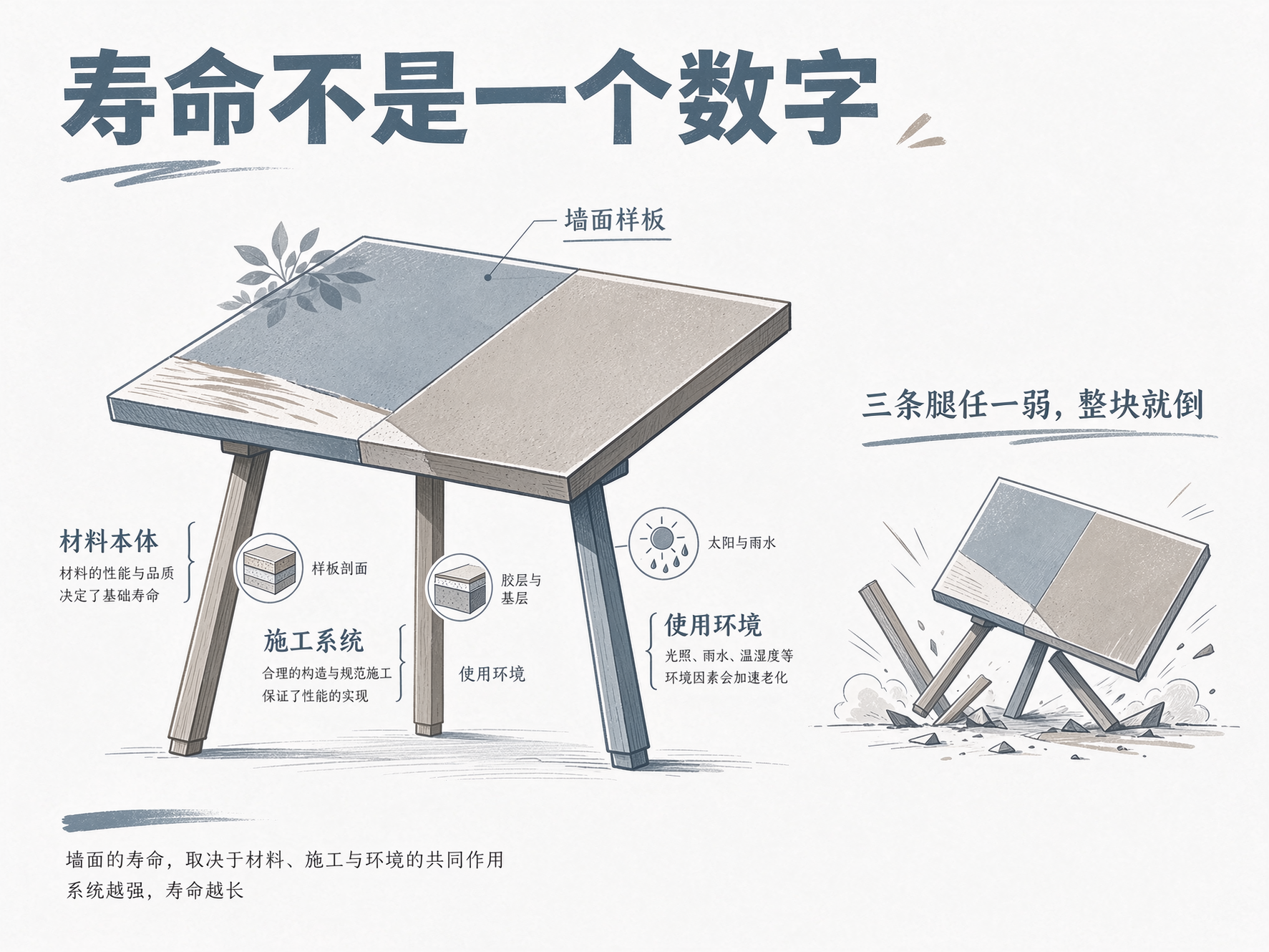
Imagine the lifespan of a wall as a table with three legs: if any one leg is weak, the tabletop cannot hold up.
The first leg is the material itself.Flexible stone is a sheet made of compounded inorganic powder, with a thickness of 2–5mm and a weight of about 3–7kg/㎡. Its weather resistance comes from the stability of the inorganic base material, not from surface coating concealment. This differs from the logic of "coatings relying on a film": coating aging starts from the surface, whereas sheet aging is holistic and slow.
The second leg is the bonding system.The sheets are fixed to the substrate by the adhesive layer, so the adhesive layer's resistance to water, heat and freeze-thaw directly determines how long the system will last. If ordinary tile adhesive is used instead of the dedicated adhesive, the problem will not be visible in the short term, but in the medium term it will first appear at joints and edges.
The third leg is the use environment.UV intensity, temperature difference range, wet-dry cycle frequency, airborne salt and pollutants all accelerate aging. The same model will not perform the same in the dry, low-rainfall northwest region as in the humid, high-salt southeast coastal region.
III. Weathering Resistance and Aging: How Exactly Are They Tested?
"How is artificial aging resistance tested" is one of the questions procurement and design should ask most. The conventional approach is accelerated aging testing: place samples in a xenon lamp aging chamber or UV aging chamber, simulate sunlight, temperature and humidity cycles, take samples at set intervals, and then examine three things—color difference change, degree of chalking, and whether blistering or cracking occurs. Damp heat testing and freeze-thaw cycles are also performed for humid and cold regions.
The criteria are usually written on these items:
- Color difference: the color shift before and after aging, measured with a colorimeter and judged against the allowable value agreed for the project.
- Chalking: whether powdery detachment appears on the surface, rated by grade.
- Appearance: presence of blistering, cracking, edge lifting, or peeling.
- Adhesion: whether the bond strength still meets requirements after aging.
It should be noted that: accelerated aging is an "equivalent estimation", not a "promised number of years". There is no universal conversion formula between test duration and actual years, and any statement that directly converts "how many hours of aging" into "how many years" is not rigorous. If a project requires a years commitment, it should go through the warranty terms, not rely on a single conversion.
IV. Four checkpoints: making service life a manageable matter
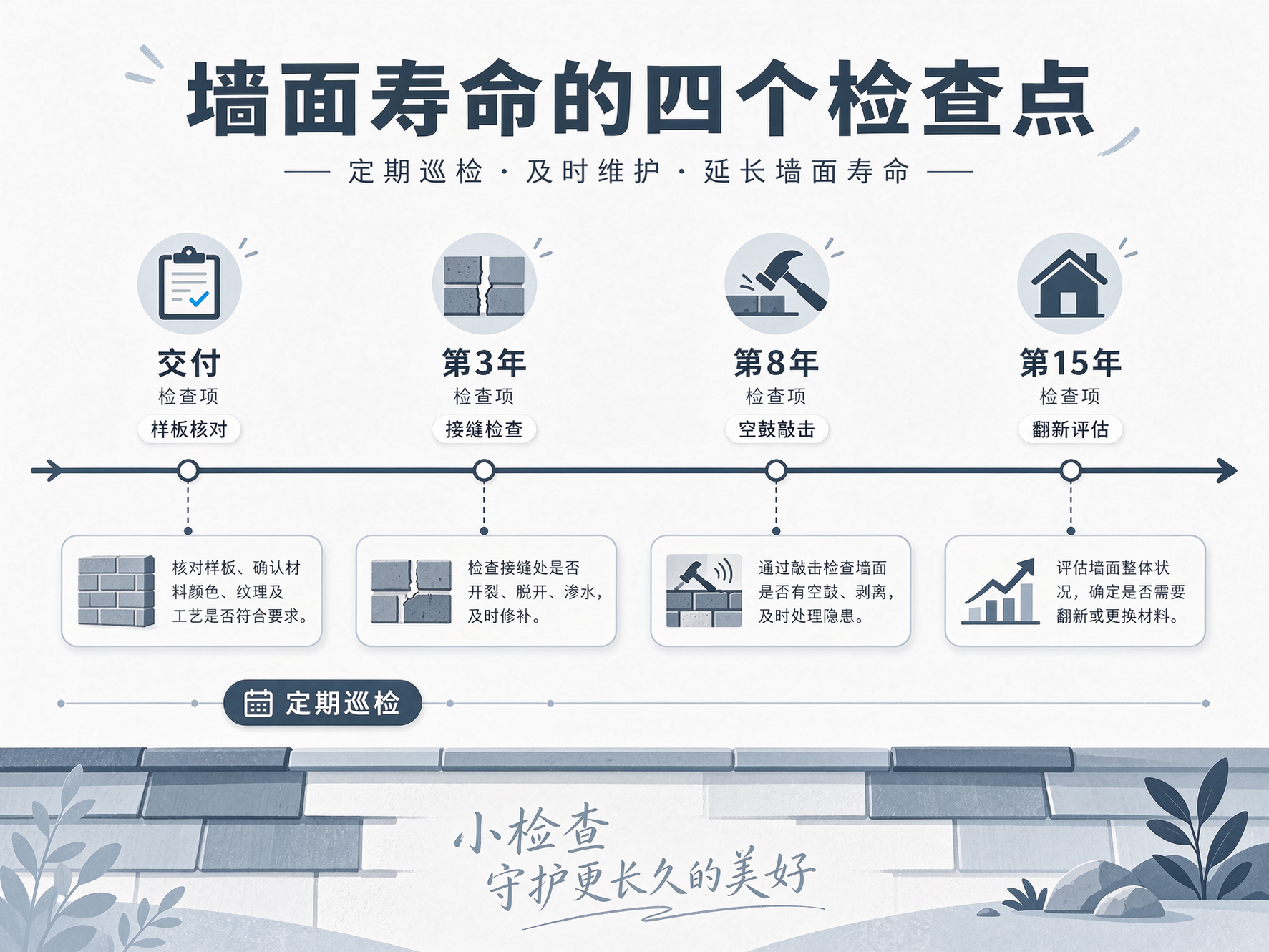
Rather than arguing about "how many years it can last," it is better to make maintenance a system. Along the timeline, a wall has four key inspection points:
- At the time of delivery.Check the sample panels against the color codes, retain file samples, record the substrate and auxiliary material models, and lock in the "baseline condition." Without a baseline, all subsequent judgments have no reference.
- The third year.Focus on joints and edges: whether joints have widened, whether edges and corners have lifted, and whether pointing has cracked. This round checks whether "the system has begun to loosen."
- The eighth year.Conduct spot checks for hollow areas by tapping, especially at the middle of large wall surfaces and at the base of columns. This round checks "whether the bonding layer has degraded."
- The fifteenth year.Conduct a whole-surface assessment: whether the color difference is obvious, whether there is accumulated local damage, and whether renovation is needed. This round examines "whether to proceed to the next round of renovation."
These four time points are engineering conventions, not material commitments. Their value lies in turning "wait for problems and then fix them" into "inspect by milestone," which greatly reduces rework costs.
V. Compared with natural stone, ceramic tiles, and aluminum veneer panels, which is more durable?
There is no single answer to this question, because the "lifespan bottleneck" of the four types of materials lies in different places:
- Natural stone.The body is extremely durable; several decades are not a problem. However, project service life is constrained by the installation system—steel frame corrosion, loosening of connectors, aging of sealant, surface contamination and efflorescence are all the first places to fail.
- Ceramic tiles.The body is weather-resistant and wear-resistant, but wall mounting relies on the bonding layer, and hollowing and detachment are the main risks; individual panels are heavy, and the exterior-wall risk is higher in renovation and high-rise projects.
- Aluminum veneer.The body is lightweight and weather-resistant; the weak points are the coating and panel-joint sealing: coating aging causes discoloration, and sealant failure allows water ingress.
- Flexible stone.The body is an inorganic composite sheet, and its weakness is likewise systemic: substrate strength, water resistance of the bonding layer, and node sealing.
So the right way to compare is not "whose service life is longer" but "at this location, whose failure mode is easier to detect and easier to repair." Stone and ceramic tile failures are often sudden (detachment), while panel and aluminum veneer failures are mostly gradual (edge warping, discoloration); the latter are easier to spot early during inspections—which is actually an advantage in public buildings.
VI. Eight specific factors that affect service life
- Substrate strength and flatness.If the substrate has dusting, hollow areas or insufficient strength, even the best adhesive layer is useless; this is the top priority.
- Substrate moisture content.If it is bonded when the moisture content is too high, the moisture is sealed inside and will later push up the sheets.
- Adhesive selection.Whether the matching flexible adhesive is used and whether construction follows the specified usage directly determines the interface strength.
- Construction environment temperature.If it is too low or too high, it will affect the curing and open time of the adhesive.
- Detail treatment.Internal and external corners, finishing joints, openings, and movement joints: these locations are stress concentration zones and are also the first to fail.
- UV and temperature difference.In areas with strong ultraviolet radiation, color fades faster; in areas with large temperature differences, repeated thermal expansion and contraction place greater demands on system flexibility.
- Humidity and salt.High salinity along the coast and high humidity in the south accelerate interface degradation and efflorescence.
- Usage and cleaning methods.Directly blasting seams with a high-pressure water gun, or using strongly acidic or alkaline cleaners, will shorten service life.
Among these eight items, the first five can be controlled at the construction stage, and the last three must be accepted at the design stage. In other words: most of the matter of service life is decided before construction begins.
VII. What exactly does the "weathering resistance service life standard" refer to
Many projects ask "what is the weather-resistance service-life standard for soft porcelain flexible stone?" The accurate answer is: there is no unified mandatory service-life standard in China specifying "how many years flexible stone must last." The actual constraints come from three levels:
- Product standards and test items.What is specified is performance indicators and test methods, such as the color difference and appearance requirements after artificial aging resistance testing, not a number of years.
- Design service life.To be determined by the designer according to building category and location, and written into the design description.
- Warranty terms.To be agreed by both the supplier and the buyer in the contract, including the warranty scope, criteria, repair responsibilities and duration.
Of these three layers, the ones that are truly binding on the owner are the second and third. So in negotiations, what you should argue about is not "can your material last twenty years," but "will the warranty scope be written clearly, will the criteria be fixed, and who is responsible if problems arise."
VIII. How to Write the "Service Life" into the Contract
- State the warranty scope clearly.Does it cover only the material itself, or the entire "material + installation" system? A warranty covering only the material has limited practical meaning.
- State the criteria clearly.What counts as a quality issue: the proportion of hollow area, the allowable color difference, the length of edge lifting, and whether local repair is permitted. If the criteria are not written down, disputes cannot be adjudicated.
- State responsibilities and response clearly.How long after a problem is found before someone arrives on site, who does the repair, who supplies the materials, and how the costs are shared. This item is often more practical than the number of years.
IX. Three common questions
Q: Is the service life the same indoors and outdoors?Not the same. Indoors there is no direct ultraviolet exposure and the temperature difference is small, so the system bears a lighter load; outdoors it must withstand ultraviolet, rain and freeze-thaw at the same time. The performance of the same model in the two environments cannot be directly applied to each other.
Q: After one renovation, will the service life become shorter?Depends on the renovation approach. Scraping off the old finish, re-leveling and then applying is equivalent to resetting the system; covering directly over the old finish is equivalent to leaving the old system's problems inside, and the service life will be compromised.
Q: If the color difference becomes larger, is it considered a failure?Not necessarily. It depends on whether the deviation exceeds the project agreement and whether it is accompanied by chalking or cracking. A change in color alone is not sufficient to determine system failure.
Q: If the color of the sample and the later replenishment stock differ, will it affect the service life?Color differences are an appearance issue, not a lifespan issue. However, color variation in replenishment stock often means a different batch; if this coincides with a change of adhesive batch, system consistency needs to be re-verified. From an engineering standpoint, it is recommended that key projects lock in the same batch, compare against retained reference samples when replenishing, and record the batch number in the acceptance records.
X. Climate Zone Differences: The Same Model, Different Rates of Degradation
The same model installed in different climate zones degrades at different rates. In engineering practice it is usually treated as four categories of environment, with different inspection frequencies and node requirements:
- The Northwest region, which is dry with little rain and large temperature differences.Strong UV and large day-night temperature differences make color fading and thermal expansion/contraction the main issues. The focus is on joint gaps and a flexible bonding system; inspections should focus on joints and color difference.
- Coastal areas with high humidity and high salt.Salt spray and humidity accelerate interface degradation, and metal edge trims are also more prone to corrosion. The focus is on moisture and corrosion protection: joint filling must be dense, and the material of edge trims must be selected correctly.
- Northern regions with cold winters and hot summers and frequent freeze-thaw cycles.Water entering the joints and then undergoing repeated freeze-thaw cycles is the most direct cause of interface damage. The focus is on waterproofing and drainage; joints must not retain water.
- In the hot, humid and rainy southern regions.Long-term high humidity increases the risk of efflorescence and mildew. The focus is on controlling the moisture content of the substrate and on ventilation conditions.
In these four types of environments, what really needs to change is the detailing method and inspection frequency, not the material model. In other words: the same material can be used across climate zones, but construction methods cannot be copied across climate zones.
XI. Next Steps
If you need to carry out a service-life assessment for a project, there are actually only four things you need to provide: the location and orientation, the climate zone, the current condition of the substrate, and the bonding system to be used. With these four, a "list of risk points for this system in that environment" can be provided, which is far more useful than a vague number of years. For related weather resistance, fire protection and full life-cycle cost information, you can refer to Exterior wall fire protection boundaries、Full life-cycle cost Two articles; for the specifications and methods of the product series, see Flexible stone product page and Travertine、Slate、Rammed earth panels Series pages. Original inspection documents are required; see Qualifications and reports page; to conduct an assessment based on project conditions, go to Contact page。
When it comes to service life, the biggest risk is treating it as a number that can be answered off the cuff. It is actually the sum of a set of conditions, a set of systems and a set of maintenance rules—write these three things clearly, and the service life will naturally hold up.



 WhatsApp

 Guangdong Public Network Security Preparation No. 44200002005257
