

How can a foreign trade company test the flexible stone market at low risk? First verify the product and delivery conditions
Flexible stone is a new type of wall material that is light, thin, has a certain flexibility and presents the texture effect of natural stone. Its common thickness is 2–5mm, and it is mainly used for the exterior walls of hotels, restaurants, commercial stores, clubs and villas. It has product-line expansion value for building-materials distributors, foreign trade companies and decorative-materials channel partners. Ninety days can be used to complete customer interviews, sample verification, quotation testing and small-order review, and then decide whether to expand product and market investment.
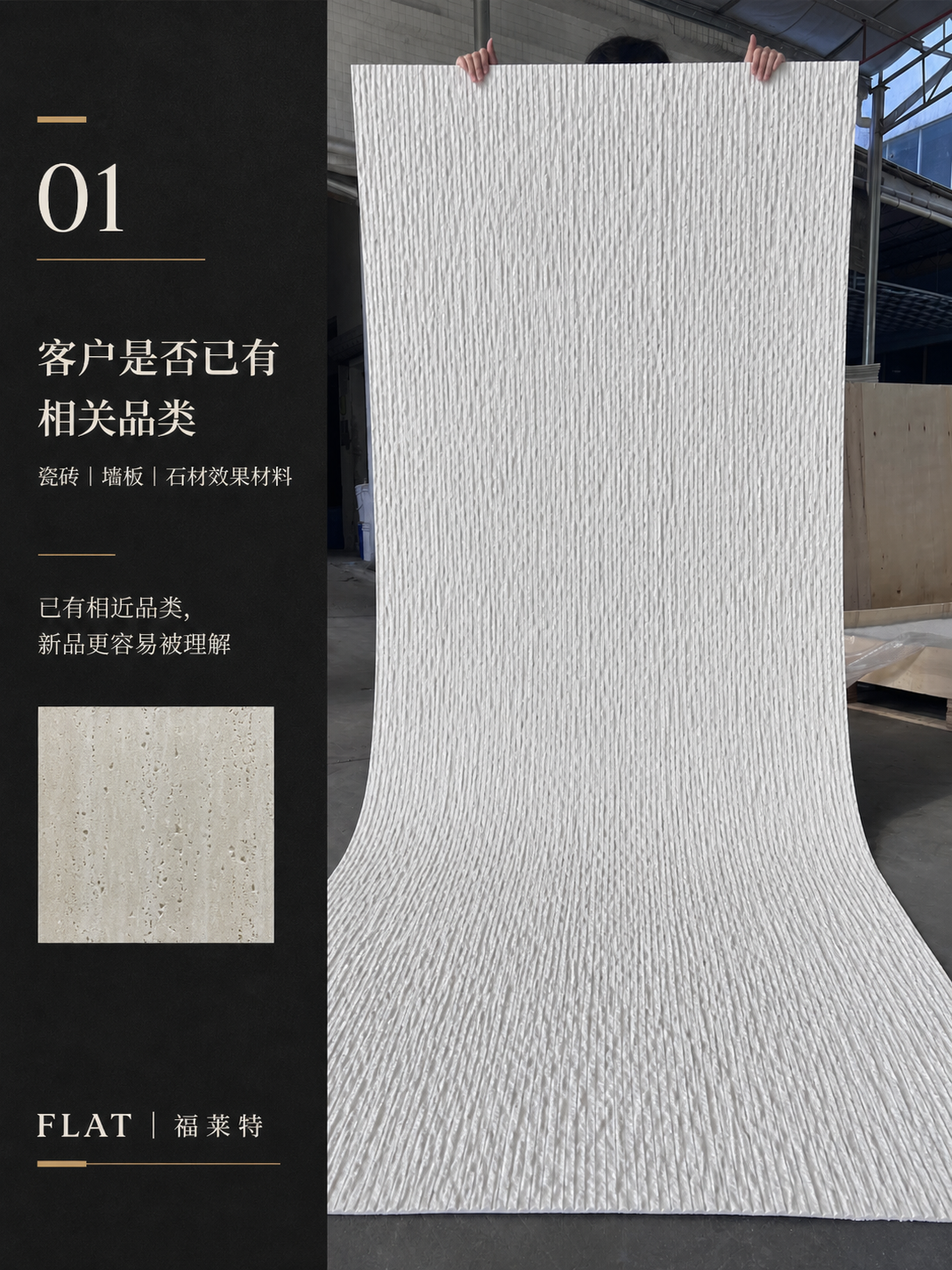
What is flexible stone?
The English name of flexible stone is Flexible Stone. It is a wall decorative material characterized mainly by being lightweight, bendable, and expressing natural stone textures. It forms flexible sheets through material molding and surface texture treatment. Different flexible stone manufacturers may have different raw material systems and processes, so procurement judgments must be based on actual samples, product descriptions, and test data.
Compared with traditional natural stone, flexible stone is generally thinner, lighter, and easier to handle for certain wall shaping, transport, and construction planning. Its common thickness is 2–5mm, with key products being 3 mm flexible stone; standard specifications may be referenced as 1200×2400mm, and weight is approximately 3–7kg/㎡. These figures represent the product range rather than a uniform commitment for all models; specific values should be based on the model data provided by FLAT or the corresponding supplier.
Flexible stone is a new type of wall material, and its value lies in adding a stone-texture solution for commercial and engineering walls, rather than replacing all natural stone. It should not be promoted as a floor paving material, nor should it be described as an all-purpose decoration material for household consumers.
Why flexible stone is gaining attention
Commercial space design trends:Hotels, restaurants, stores and clubs need to establish spatial identity through wall materials, and products with visual languages such as travertine and slate can expand design expression.
Demand for lightweight materials:For commercial renovation, exterior walls and cross-regional supply, weight, transportation, handling and substrate conditions are comprehensively evaluated. The lightweight characteristics of flexible stone make it an assessable new option.
Construction efficiency requirements:Material specifications, weight, cutting, matching auxiliary materials, and construction organization all affect the project schedule. Channel partners need to provide complete information from sample selection to delivery, not just sell individual pieces of material.
Competitive pressure from traditional channels:Conventional products such as ceramic tiles, stone and wall panels easily fall into homogeneous price comparison. Flexible stone can help channel partners build differentiated sample boards and project proposals.
New material market opportunities:Distributors and foreign trade companies can verify customer demand through a small number of samples, clear item numbers and small-batch orders, and gradually decide on the product mix and inventory investment.
What value does flexible stone offer to building materials channel distributors?
Add a product line
Tile business owners, stone business owners, wall panel distributors and decorative material agents already serve design, construction, project procurement or commercial property owners. Adding flexible stone offers an opportunity to reuse these customer relationships and supplement stone-texture wall solutions. New products should still first be validated through customer interviews, samples and trial orders.
Enhance competitive differentiation
Differentiation is not about adding a product name, but about forming a solution that can be displayed, explained, quoted, and delivered. Channel partners can build a sample combination around 3mm flexible stone and clearly define the texture, specifications, scope of application, and purchasing conditions.
Meets commercial project requirements
Hotels, restaurants and commercial stores focus simultaneously on spatial effect, material weight, schedule and delivery stability. If channel partners can coordinate sample selection, sealed samples, quantity calculation, packaging and construction documentation, they can enhance their project service capability.
open up new market opportunities
Domestic channels can connect design, construction, and project procurement, while foreign trade companies can serve importers, Distributors, and project material suppliers. A more reliable approach is to first select a market segment, then use samples, quotations, and small-order data to decide whether to expand.
Flexible stone product features
- Lightweight advantages:Weight is approximately 3–7kg/㎡, which helps reduce handling and transport pressure in some projects; specific weight is confirmed by model.
- Thin design:Common thickness 2–5mm; 3mm flexible stone is suitable for channel partners to focus on evaluating and making samples.
- Flexibility performance:The product has a certain degree of flexibility, but the bending radius, substrate and joints must be verified through samples and technical solutions.
- Construction convenience:Lightweight features help with handling and cutting, but the actual effect still depends on the substrate, auxiliary materials, personnel and environment.
- Natural stone veining effect:It can provide a stone visual appearance; before ordering, texture, color, layout and batch management should be confirmed.
Flexible stone application scenarios
Hotel space
Can be evaluated for lobby, public area and guest room wall surfaces; the project should confirm fire safety, weather resistance, bonding, maintenance and local code requirements.
Restaurant spaces
It can be used for brand display walls and feature walls; when selecting materials, cleaning, impact locations, business environment and construction window should be considered.
Commercial space
It can be used for store wall surfaces and display areas. The standard specification 1200×2400mm can serve as a basis for communication; layout, waste, and transportation must be reviewed per project.
Villas and high-end buildings
It can be used for villa exterior wall decoration that meets system requirements; climate, substrate, bonding system, details, waterproofing and testing requirements must be verified.
The goal of the ninety-day test is to obtain decision-making evidence, not to pursue false popularity
The first 30 days are used to determine one target market and two types of target customers, compile lists of potential importers, distributors, and project material suppliers, and interview them about their existing wall products, commonly used textures, applications, price bands, documents, and purchasing concerns. At the same time, select a small number of flexible stone samples and establish unified item numbers and documentation.
Days 31 to 60 are for displaying samples and testing quotations. Sales staff should record the textures customers select, feedback on 3mm flexible stone and the 1200×2400mm specification, project applications, estimated quantities, and reasons for rejection. Quotations must include product, packaging, delivery time, and trade terms, avoiding the use of vague low prices to trade for invalid inquiries.
From day 61 to day 90, drive high-intent customers to sample confirmation or small-batch trial orders, and review the effective reply rate, sample selection rate, quotation rate, order likelihood, full cost, and supply risk. If feedback is concentrated and delivery is controllable, you may expand the SKU or customer list; if demand is weak or conditions do not match, you should adjust the market or channel, or stop investing.
How should a flexible stone supplier be selected?
- Production and supply capability:Verify the sampling, production scheduling, replenishment, and customization processes for the target texture, thickness, and specifications.
- Product stability:Compare samples with bulk goods and across different batches for color, texture, thickness, dimensions, and surface condition.
- Quality inspection:Check the product, standard, date, conclusion and scope of application in the report against the market and intended use.
- Sample support:Samples, electronic catalogs, quotations and orders should use a consistent item number, and confirmation records should be retained.
- Export experience:Evaluate English materials, packaging labels, trade documents, communication for the destination market and exception handling capability.
- After-sales service:Confirm arrival, batch, construction communication, evidence requirements, boundaries of responsibility and handling procedures.
When searching for Flexible Stone Manufacturer or Flexible Stone Supplier, you should not compare only web page descriptions. It is recommended to complete document verification, sample confirmation, and small-batch trial orders before deciding on long-term channel cooperation.
FLAT brand introduction
FLAT focuses on the R&D and supply of flexible stone products and provides flexible stone cooperation solutions for building-materials channel distributors, foreign trade companies, and decorative materials enterprises. Brand content focuses on flexible stone supply, product support, channel cooperation, and engineering application support. Buyers should still confirm product capabilities and delivery boundaries based on project and market requirements through formal samples, technical materials, testing documents, and order terms.
Common Questions
Can ninety days determine whether a market is a success?
This can form preliminary evidence, but it cannot prove long-term success; the results are used to decide whether to continue, adjust, or stop, rather than as an absolute prediction.
How many countries should be selected for market testing?
When resources are limited, it is advisable to focus on one market first to avoid excessive fragmentation across languages, regulations, customers, and feedback.
Is it necessary to stock up in large quantities during the testing phase?
Usually not required. Samples, clear delivery times and small trial orders can be used for verification first, and inventory strategy should be based on real demand.
Which customers should be contacted?
Prioritize contacting distributors, importers, and project material suppliers that handle wall materials, serve commercial projects, and have sample display or import capabilities.
How to judge whether an inquiry is valid?
An effective inquiry usually includes application, specifications, quantity, timing, market or documentation requirements, and a willingness to move forward with samples or a specific quotation.
Does test failure mean flexible stone has no market?
Not necessarily; it may be due to customer choice, product mix, price, messaging or market mismatch. The specific cause should be determined based on records.
Internal link suggestions
- View FLAT flexible stone product categories
- Learn about flexible stone products and applications
- View flexible stone engineering applications
- Learn about FLAT
- Contact Fulaite to discuss samples and channel cooperation



 WhatsApp

 Guangdong Public Network Security Preparation No. 44200002005257
